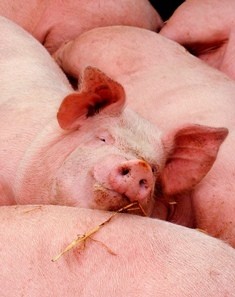
Domestic Pigs
An international team of scientists, including researchers at Durham University, have revealed the genetic code of pigs for the first time, providing new insights into their domestication and the movements of early humans. Researchers compared the genome or genetic make-up of domestic pigs with those of wild boars - from which domestic pigs are descended. Their study found significant genetic differences between wild boar from Asia and Europe, which split from a common ancestor around a million years ago. These differences are also reflected in the genes of current day Western and Chinese breeds of domestic pigs, confirming that pigs were independently domesticated in western Eurasia and East Asia. The study was led by scientists at The Roslin Institute at the University of Edinburgh and the Wellcome Trust Sanger Institute, Wageningen University and the University of Illinois. Durham University was involved in the interpretation of the genomic analyses with respect to domestic pigs. Greger Larson, in the Department of Archaeology, at Durham University, said the new research would provide opportunities to further understand the process and pattern of pig domestication, which could ultimately shed new light on the movements of early humans.
TO READ THIS ARTICLE, CREATE YOUR ACCOUNT
And extend your reading, free of charge and with no commitment.