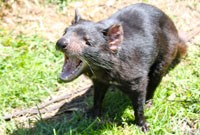
Tasmanian devil by variationblogr/Flickr.
Researchers have mapped the genome of the Tasmanian Devil for the first time, a crucial step towards understanding the transmissible facial tumours decimating Devil populations and related human cancers. The international team, led by Janine Deakin of the Research School of Biology at The Australian National University, compared the normal Tasmanian Devil genome to that of the Devils with facial tumours and found that significant fragments of the chromosomes had been jumbled, like a jigsaw puzzle put together the wrong way. Their research is published in this month's edition of PLoS Genetics . The first case of devil facial tumour disease was recorded in 1996. While Devils can die from the cancer, thousands more have died through starvation, as the disease deforms their faces so badly that they can't eat. The aggressive carnivores contract the cancer through biting and jaw wrestling with Devils that are already infected. Deakin's team found that, surprisingly, the Devil tumour is evolving very slowly and has changed very little since its emergence 16 years ago.
TO READ THIS ARTICLE, CREATE YOUR ACCOUNT
And extend your reading, free of charge and with no commitment.