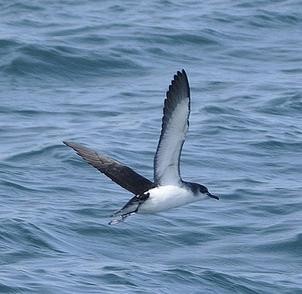
Manx Shearwater 18 February 2012 by Eric Bowles by Georgia eBirder on flickr
The behaviour of seabirds during migration - including patterns of foraging, rest and flight - has been revealed in new detail using novel computational analyses and tracking technologies. Using a new method called 'ethoinformatics', described as the application of computational methods in the investigation of animal behaviour, scientists have been able to analyse three years of migration data gathered from miniature tracking devices attached to the small seabird the Manx Shearwater ( Puffinus puffinus ). The Manx Shearwater is currently on the 'amber' list of UK Birds of Conservation Concern. Up to 80% of the world population breeds in the UK, travelling 20,000km each year in their migrations to South America and back. In a continuing long-term collaboration, researchers at UCL and the University of Oxford collected data over three consecutive years. In this study, published in the Royal Society journal Interface , they show that the migration of the Manx Shearwater contains a complex pattern of three behavioural states; rest, flight and foraging. Results indicate that in winter, birds spend much less time foraging and in flight than in breeding season.
TO READ THIS ARTICLE, CREATE YOUR ACCOUNT
And extend your reading, free of charge and with no commitment.