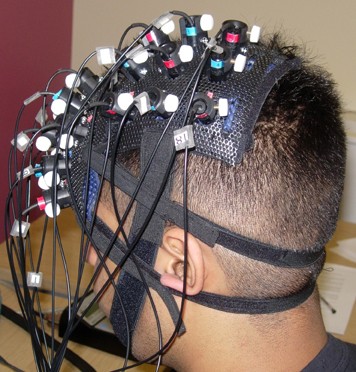
a healthy adult performs anagram tasks while scientists monitor the function of the brain using near-infrared spectroscopy (NIRS).
With just a few days of non-harmful brain stimulation and brain training, scientists have improved people's ability to manipulate numbers for up to six months. In new research, scientists at the University of Oxford and UCL suggest that applying non-invasive stimulation, called transcranial random noise stimulation (TRNS), to the brain can improve its function. Roi Cohen Kadosh, of the University of Oxford, said: "With just five days of cognitive training and noninvasive, painless brain stimulation, we were able to bring about long-lasting improvements in cognitive and brain functions," Incredibly, the improvements held for a period of six months after training. The research was supported by the Wellcome Trust and is published in the journal Current Biology . To measure what was happening in the brain during stimulation, the team used an optical brain imaging technique called near-infrared spectroscopy (NIRS), which monitors the changes in brain blood volume and oxygen levels. Results from the NIRS imaging suggested that enhanced efficiency in the blood flow between neurons correlated with the improved cognitive ability of participants. Near-infrared spectroscopy or NIRS is an optical technique that uses low light levels to measure non-invasively the distribution of oxygen and blood in the brain.
TO READ THIS ARTICLE, CREATE YOUR ACCOUNT
And extend your reading, free of charge and with no commitment.