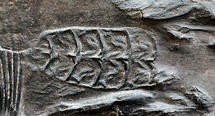
Scientists have found that early remoras had suckers on their backs.
A 30-million-year-old fossil has revealed how remoras - also called sharksuckers - evolved the sucker that enables them to stick to other fish and 'hitch a ride'. Previous evidence, such as the segmented structure of the sucker and how it develops in a similar way to fins in normal fish, led scientists to believe that it must be a modified dorsal fin - the fin located on the back of normal fish. But the evolutionary steps that led from fin to sucker were a mystery. Now a team led by scientists from Oxford University and London's Natural History Museum has studied an early fossil remora and found that it evolved a fully-functioning sucker - or 'adhesion disc' - on its back. It was only later in the evolutionary history of remoras that the sucker migrated to the top of the head, where it is found in all remoras alive today. A report of the research is published in the journal Proceedings of the Royal Society B . 'The remora sucker is a truly amazing anatomical specialisation but, strange as it may seem, it evolved from a spiny fin,' said Dr Matt Friedman of Oxford University's Department of Earth Sciences, lead author of the report.
TO READ THIS ARTICLE, CREATE YOUR ACCOUNT
And extend your reading, free of charge and with no commitment.