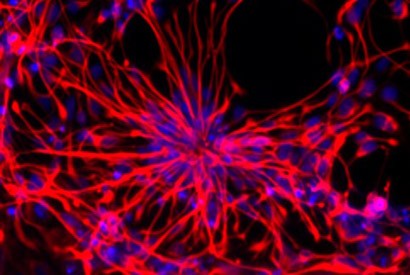
Pluripotent stem cells, created from human skin or mouse ear tissue, are shown here developing into neurons. Cell nuclei are shown in blue, and the red highlights a type of filament protein expressed in nerve cells. (Image courtesy of Song Li’s lab)
Bioengineers at UC Berkeley have shown that physical cues can replace certain chemicals when nudging mature cells back to a pluripotent stage, capable of becoming any cell type in the body. The researchers grew fibroblasts - cells taken from human skin and mouse ears - on surfaces with parallel grooves measuring 10 micrometers wide and 3 micrometers high. After two weeks of culture in a special cocktail used to reprogram mature cells, the researchers found a four-fold increase in the number of cells that reverted back to an embryonic-like state compared with cells grown on a flat surface. Growing cells in scaffolds of nanofibers aligned in parallel had similar effects. The study, published online today (Sunday, Oct. 20) , could significantly enhance the process of reprogramming adult cells into embryonic-like stem cells that can differentiate, or develop, into any type of tissue that makes up our bodies. The 2012 Nobel Prize in Physiology or Medicine was awarded to scientists who discovered that it was possible to reprogram cells using biochemical compounds and proteins that regulate gene expression.
TO READ THIS ARTICLE, CREATE YOUR ACCOUNT
And extend your reading, free of charge and with no commitment.