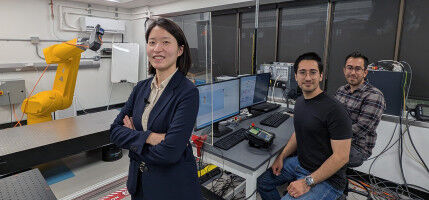
Vivek Shenoy
The idea of growing replacement tissue to repair an organ, or to swap it out for an entirely new one, is rapidly transitioning from science fiction to fact. Tissue engineering techniques are improving in their ability to generate three-dimensional masses of cells and provide them with vascular systems for keeping them alive, but a more mathematically rigorous approach for designing these tissues is still needed. Researchers at the University of Pennsylvania, Brown University and ETH Zurich have now used a series of experiments to develop a dynamic model of the stresses that stretch growing tissue. This model is the first to take into account the complicated feedback effects of cells' molecular motors, which can respond to external stress by pulling harder on their environment, eventually tearing the tissue apart. The study was led by Vivek Shenoy , professor in the School of Engineering and Applied Science's Department of Materials Science and Engineering , Christopher Chen, then a professor in the Department of Bioengineering , and Jeffrey Morgan of Brown's Center for Biomedical Engineering. Hailong Wang, a member of Shenoy's lab, was the study's lead author; Thomas Boudou of Chen's lab, Alexander Svoronos and Jacquelyn Youssef Schell of Brown, and Mahmut Selman Sakard of ETH Zurich also contributed to the research. It was published in the Proceedings of The National Academy of Sciences.
TO READ THIS ARTICLE, CREATE YOUR ACCOUNT
And extend your reading, free of charge and with no commitment.