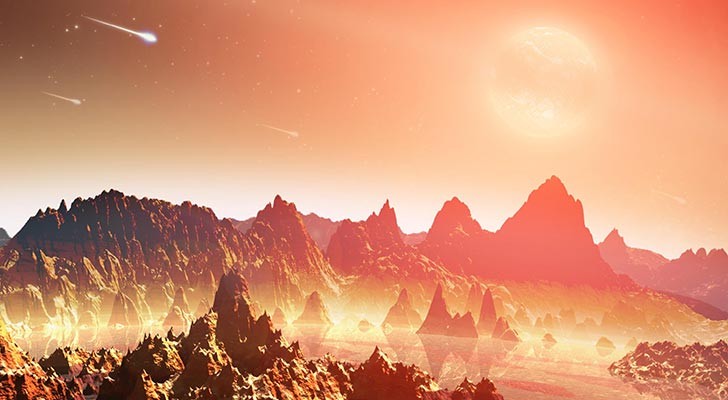
Photo illustration by NASA This artist’s conception shows a young, hypothetical planet around a cool star. A soupy mix of potentially life-forming chemicals can be seen pooling around the base of the jagged rocks.
Most astrobiologists believe that life in some form is likely to exist away from Earth. But new research demonstrates that life as we know it on Earth might never have come to exist at all if not for a key element delivered to the planet by meteorites billions of years ago. Scientists at the University of Washington and the University of South Florida found that during the Hadean and Archean eons - the first two of the four principal eons of the Earth's earliest history - the heavy bombardment by meteorites provided reactive phosphorus essential for creating the earliest life on Earth. When released in water, that reactive phosphorus could be incorporated into prebiotic molecules, and the researchers documented its presence in early Archean limestone, showing it was abundant some 3.5 billion years ago. "The importance of this finding is that it provides the missing ingredient in the origin-of-life recipe: a form of phosphorus that can be readily incorporated into essential biological molecules like nucleic acids and cell-membrane lipids,” said Roger Buick , a UW professor of Earth and space sciences. Buick is a co-author of a paper explaining The lead author is Matthew Pasek, an assistant professor of geology at the University of South Florida. The scientists concluded that the meteorites delivered phosphorus in minerals that are not now seen on the surface of the Earth, and these minerals corroded in water to release phosphite, a form of phosphorus seen only on the early Earth.
TO READ THIS ARTICLE, CREATE YOUR ACCOUNT
And extend your reading, free of charge and with no commitment.