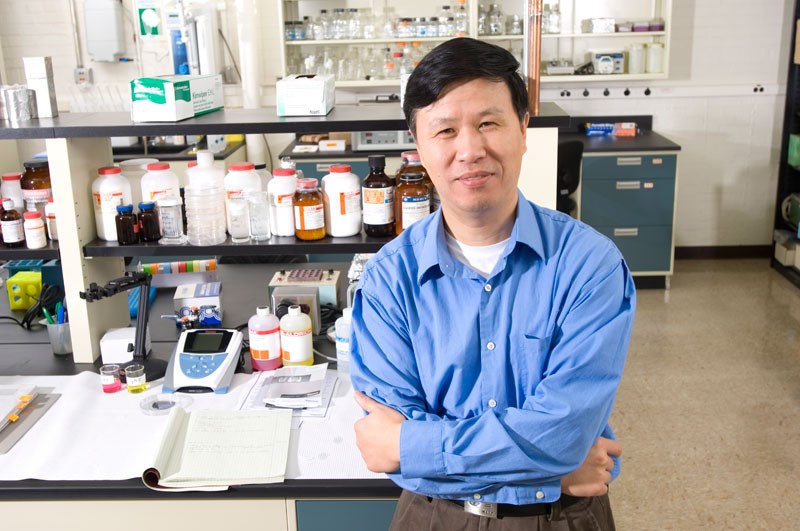
Ning Wang led a team that found the precise combination of mechanical forces, chemistry and timing to help stem cells differentiate into three germ layers, the first step toward developing specialized tissues and organs.
CHAMPAIGN, Ill. The gap between stem cell research and regenerative medicine just became a lot narrower, thanks to a new technique that coaxes stem cells, with potential to become any tissue type, to take the first step to specialization. It is the first time this critical step has been demonstrated in a laboratory. University of Illinois researchers, in collaboration with scientists at Notre Dame University and the Huazhong University of Science and Technology in China, published their results . "Everybody knows that for an embryo to form, somehow a single cell has a way to self-organize into multiple cells, but the in vivo microenvironment is not well understood," said study leader Ning Wang, a professor of mechanical science and engineering at the U. of I. "We want to know how they develop into organized structures and organs. It doesn't happen by random chance. There are biological rules that we don't yet understand." During fetal development, all the specialized tissues and organs of the body form out of a small ball of stem cells.
TO READ THIS ARTICLE, CREATE YOUR ACCOUNT
And extend your reading, free of charge and with no commitment.