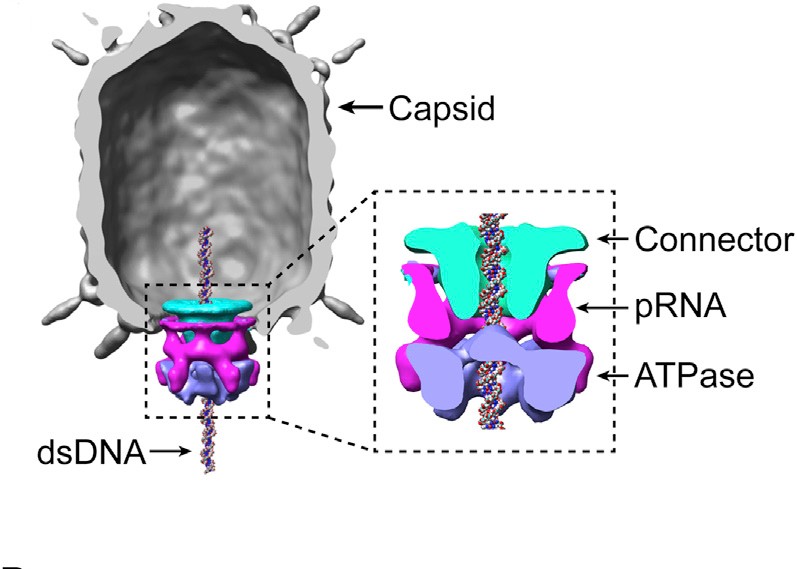
Cryoelectron microscopy reconstruction of the Phi 29 capsid (gray), connector (cyan), pRNA (magenta), and ATPase ring (blue).
Viruses are the enigma of the biological world - despite having their own DNA and being able to adapt to their environment and evolve, they are not considered to be alive like cells. In order to reproduce and multiply - a requirement of "life" - a virus must invade a living cell, eject its DNA into that of the cell, and commandeer the cell's biological machinery. While a virus, essentially, may be nothing more than a dollop of DNA packed into a protective coating of protein called a capsid, the packaging of that DNA is critical. The molecular motors that drive this DNA packaging process, however, have remained almost as enigmatic as the viruses themselves. A better understanding of these motors could be crucial to combating viral infections. Studying molecular motors is the signature work of Carlos Bustamante, a biophysicist who holds joint appointments with Lawrence Berkeley National Laboratory (Berkeley Lab) and the University of California (UC) Berkeley, as well as the Howard Hughes Medical Institute (HHMI) and the Kavli Energy NanoSciences Institute at Berkeley. In his latest research, he and a team of collaborators have shed new light on a type of molecular motor used to package the DNA of a number of viruses, including such human pathogens as herpes and the adenoviruses.
TO READ THIS ARTICLE, CREATE YOUR ACCOUNT
And extend your reading, free of charge and with no commitment.