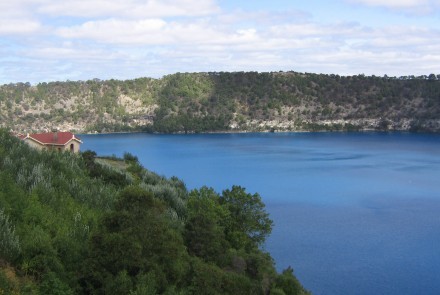
The Blue Lake in the dormant volcano at Mount Gambier. Image courtesy of Bjorn Hornemann on flickr
Scientists have solved a long-standing mystery surrounding Australia's only active volcanic area, in the country's southeast. The research explains a volcanic region that has seen more than 400 volcanic events in the past four million years. The 500 kilometre long region stretches from Melbourne to the South Australian town of Mount Gambier, which surrounds a dormant volcano that last erupted only 5,000 years ago. "Volcanoes in this region of Australia are generated by a very different process to most of Earth's volcanoes, which occur on the edges of tectonic plates, such as the Pacific Rim of Fire", says lead researcher Dr Rhodri Davies. "We have determined that the volcanism arises from a unique interaction between local variations in the continent's thickness, which we were able to map for the first time, and its movement, at seven centimetres a year northwards towards New Guinea and Indonesia. The volcanic area is comparatively shallow, less than 200 kilometres deep, in an area where a 2.5 billion year-old part of the continent meets a thinner, younger section, formed in the past 500 million years or so. These variations in thickness drive currents within the underlying mantle, which draw heat from deeper up to the surface.
TO READ THIS ARTICLE, CREATE YOUR ACCOUNT
And extend your reading, free of charge and with no commitment.