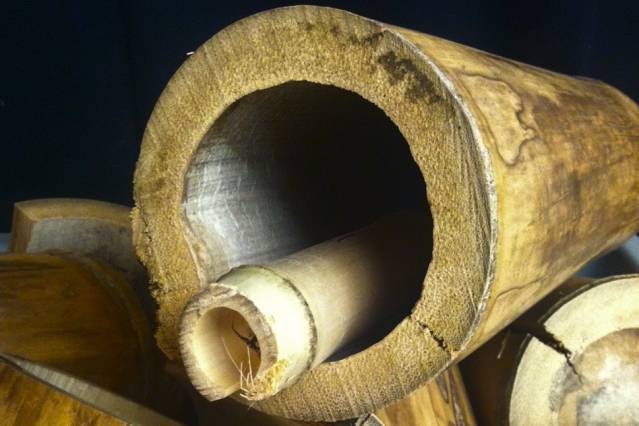
Researchers in Gibson’s lab have collected bamboo samples of various thicknesses to analyze bamboo’s microstructure.
Bamboo construction has traditionally been rather straightforward: Entire stalks are used to create latticed edifices, or woven in strips to form wall-sized screens. The effect can be stunning, and also practical in parts of the world where bamboo thrives. But there are limitations to building with bamboo. The hardy grass is vulnerable to insects, and building with stalks - essentially hollow cylinders - limits the shape of individual building components, as well as the durability of the building itself. MIT scientists, along with architects and wood processors from England and Canada, are looking for ways to turn bamboo into a construction material more akin to wood composites, like plywood. The idea is that a stalk, or culm, can be sliced into smaller pieces, which can then be bonded together to form sturdy blocks - much like conventional wood composites. A structural product of this sort could be used to construct more resilient buildings - particularly in places like China, India, and Brazil, where bamboo is abundant.
TO READ THIS ARTICLE, CREATE YOUR ACCOUNT
And extend your reading, free of charge and with no commitment.