Shown here are blow formed, bulk metallic glass samples.
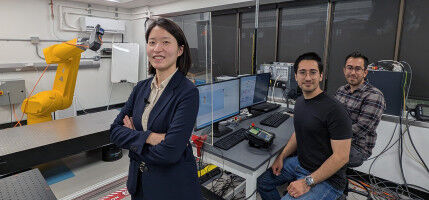
Yale engineer Jan Schroers will lead a three-year, $1.2 million project intended to dramatically accelerate the pace of discovering and characterizing bulk metallic glasses (BMGs), a versatile type of pliable glass that's stronger than steel. The grant, awarded as part of the National Science Foundation's program for Designing Materials to Revolutionize and Engineer our Future, will enable Schroers' team to screen more than 3,000 potential BMG alloys in a week, a vast improvement over traditional methods that take as much as a full day to identify a single alloy. "With this project, we can bring materials discovery to a new level, reducing the time for identifying all possible BMG alloys from a projected 4,000 years to perhaps as little as four years," said Schroers, a professor of mechanical engineering and materials science at the Yale School of Engineering & Applied Science. The project will produce and characterize millions of potential BMGs, a significant increase over the 120,000 BMGs produced and characterized to date by traditional methods - just 100 of which are good glass formers. The key to this advancement, said Schroers, is the combination of three integrated computational and experimental techniques, each pioneered by a different team member. First, Stefano Curtarolo of Duke University will use combinatorial simulations to rapidly analyze the crystalline structures for thousands of potential alloys. Schroers will then examine the fabrication abilities of the best alloys identified by Curturaolo by simultaneously testing thousands of millimeter-size, controllably-mixed alloys for their ability to generate bubble gum-like bubbles - a technique that indicates alloy pliability.
TO READ THIS ARTICLE, CREATE YOUR ACCOUNT
And extend your reading, free of charge and with no commitment.