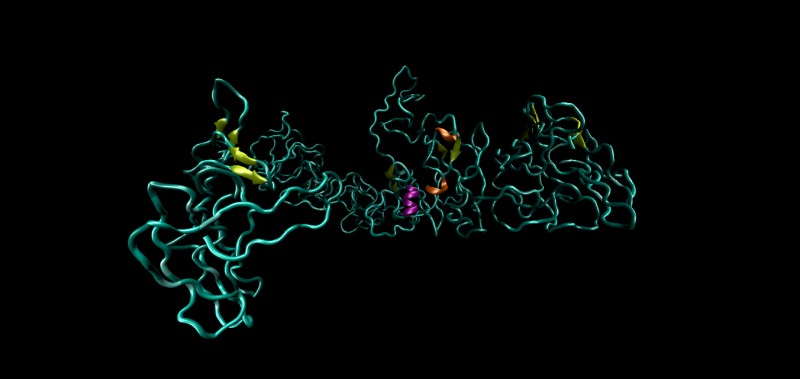
Matthew Zelisko, University of Houston An illustration of the molecular structure of tropoelastin, the smallest unit of the protein elastin.
University of Washington - Posted under: Engineering , Health and Medicine , News Releases , Research , Science Measurements taken at the molecular scale have for the first time confirmed a key property that could improve our knowledge of how the heart and lungs function. University of Washington researchers have shown that a favorable electrical property is present in a type of protein found in organs that repeatedly stretch and retract, such as the lungs, heart and arteries. These findings are the first that clearly track this phenomenon, called ferroelectricity, occurring at the molecular level in biological tissues. "We wanted to bring in different experimental techniques, evidence and theoretical understanding of ferroelectricity in biological functions,” said Jiangyu Li , a UW professor of mechanical engineering and corresponding author of the paper. "We certainly have much more confidence now in the phenomenon itself. Ferroelectricity is a response to an electric field in which a molecule switches from having a positive to a negative charge. This switching process in synthetic materials serves as a way to power computer memory chips, display screens and sensors.
TO READ THIS ARTICLE, CREATE YOUR ACCOUNT
And extend your reading, free of charge and with no commitment.