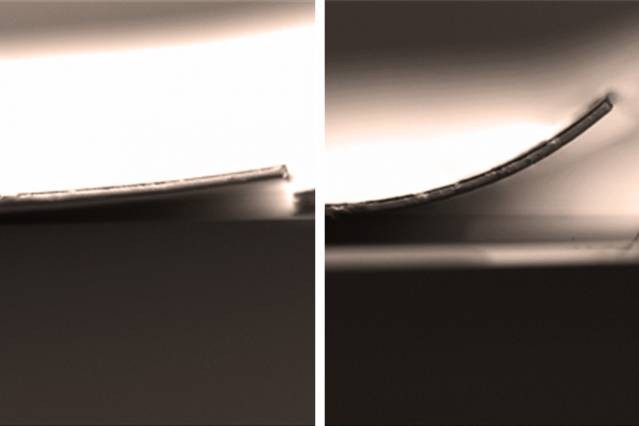
To test the properties of bonded surfaces, researchers used layered materials (in this case a chromium layer bonded to a silica layer by a layer of epoxy), that were pulled apart, sliced in cross-section, and imaged with a scanning electron microscope. At left, a dry sample shows no debonding of the layers, but at right, a sample exposed to moisture for four weeks shows significant debonding.
Materials that are firmly bonded together with epoxy and other tough adhesives are ubiquitous in modern life - from crowns on teeth to modern composites used in construction. Yet it has proved remarkably difficult to study how these bonds fracture and fail, and how to make them more resistant to such failures. Now researchers at MIT have found a way to study these bonding failures directly, revealing the crucial role of moisture in setting the stage for failure. Their findings are published in the journal Proceedings of the National Academy of Science in a paper by MIT professors of civil and environmental engineering Oral Buyukozturk and Markus Buehler; research associate Kurt Broderick of MIT's Microsystems Technology Laboratories; and doctoral student Denvid Lau, who has since joined the faculty at the City University of Hong Kong. "The bonding problem is a general problem that is encountered in many disciplines, especially in medicine and dentistry," says Buyukozturk, whose research has focused on infrastructure, where such problems are also of great importance. "The interface between a base material and epoxy, for example, really controls the properties. If the interface is weak, you lose the entire system." "The composite may be made of a strong and durable material bonded to another strong and durable material," Buyukozturk adds, "but where you bond them doesn't necessarily have to be strong and durable." Besides dental implants and joint replacements, such bonding is also critical in construction materials such as fiber-reinforced polymers and reinforced concrete.
TO READ THIS ARTICLE, CREATE YOUR ACCOUNT
And extend your reading, free of charge and with no commitment.