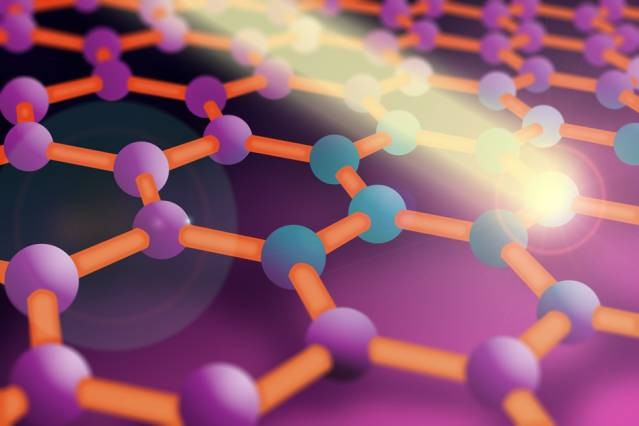
Researchers at MIT have found a way to control how graphene conducts electricity by using extremely short light pulses. In this illustration, a lattice of graphene is shown with its bonds (bars) connecting carbon atoms (balls). When the light pulse hits the atoms, electrons can accumulate or diminish in number. By controlling the concentration of electrons in a graphene sheet, researchers can change the material’s electrical conductivity.
Graphene, an ultrathin form of carbon with exceptional electrical, optical, and mechanical properties, has become a focus of research on a variety of potential uses. Now researchers at MIT have found a way to control how the material conducts electricity by using extremely short light pulses, which could enable its use as a broadband light detector. The new findings are published in the journal Physical Review Letters , in a paper by graduate student Alex Frenzel, Nuh Gedik, and three others. The researchers found that by controlling the concentration of electrons in a graphene sheet, they could change the way the material responds to a short but intense light pulse. If the graphene sheet starts out with low electron concentration, the pulse increases the material's electrical conductivity. This behavior is similar to that of traditional semiconductors, such as silicon and germanium. But if the graphene starts out with high electron concentration, the pulse decreases its conductivity - the same way that a metal usually behaves.
TO READ THIS ARTICLE, CREATE YOUR ACCOUNT
And extend your reading, free of charge and with no commitment.