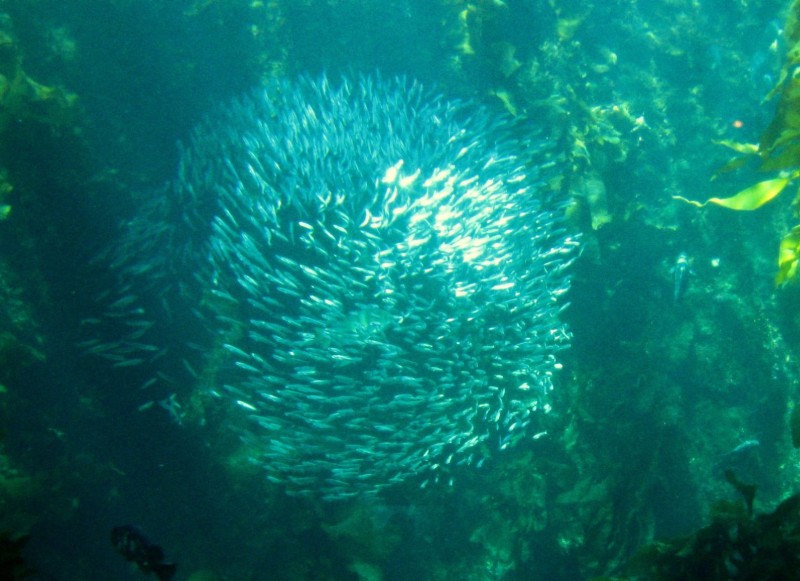
Jared Zimmerman / Flickr A school of small fish in the Monterey Bay Aquarium.
University of Washington - The largest migration on the planet is the movement of small animals from the surface of the open ocean, where they feed on plants under cover of darkness, to the sunless depths where they hide from predators during the day. University of Washington researchers have found that this regular migration helps shape our oceans. During the daylight hours below the surface the animals release ammonia, the equivalent of our urine, that turns out to play a significant role in marine chemistry, particularly in low-oxygen zones. Results are published online this week in the Proceedings of the National Academy of Sciences. "I'm very fascinated by these massive migrations,” said lead author Daniele Bianchi , a postdoctoral researcher in the UW School of Oceanography. "To me, it's exciting to think about the effects of animal behavior on a large scale in the ocean. One might not think that peeing into the vastness of the oceans could have an effect.
TO READ THIS ARTICLE, CREATE YOUR ACCOUNT
And extend your reading, free of charge and with no commitment.