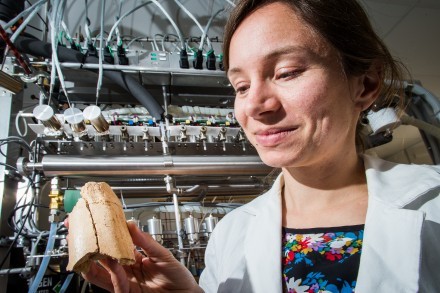
Dr Rachel Wood with a 40,000 year old bone of a red deer, showing cut marks made by human. Image: Stuart Hay
Neanderthal groups lived alongside modern humans for several thousand years, an international team of scientists has found, overturning previous theories about the extinction of Neanderthals. The team applied a new radiocarbon dating method which revealed that Neanderthals across Europe did not all die out at one time as modern humans appeared. "The two groups lived in neighboring regions for several thousand years," said Dr Rachel Wood from the Research School of Earth Sciences at The Australian National University. "They would have had plenty of time to interact." Recent genetic studies have shown that non-African humans interbred with Neanderthals, but there was little evidence to show where or how often this occurred. However this latest study suggests Neanderthals and modern humans overlapped in Europe around 40,000 years ago, for between 2,600 and 5,400 years. Dr Wood was part of the international research team, led by Professor Thomas Higham from the University of Oxford, which published its findings in the latest edition of Nature http://dx.doi.org/10.1038/nature13621 . The team analysed around 200 samples of bone, charcoal and shell from 40 key archeological sites across Europe.
TO READ THIS ARTICLE, CREATE YOUR ACCOUNT
And extend your reading, free of charge and with no commitment.