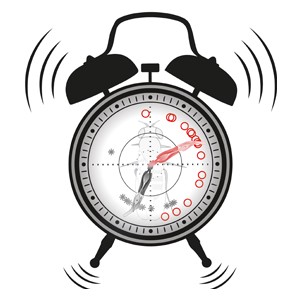
The image shows an
alarm clock, symbolizing the circadian clock. The pointers of the clock are
formed by scolopidia, i.e. those mechanosensory units that provide information
to the fly’s circadian clock. The red pointer shows the mean circadian
time after flies were vibrated. The other pointer is grey and depicts the
circadian time without vibration. Credit: Faxen/Albert, UCL.
The internal circadian clock of a Drosophila (fruit fly) can be synchronised using vibrations, according to research published today in the journal Science . The study suggests that an animal's own movements can influence its clock. The circadian clock, which underlies the daily rhythms characterising most of our bodily functions, including the sleep cycle, is mainly set by diurnal changes in light and temperature. Researchers at UCL and Queen Mary, University of London, have now shown that exposure to 12-hour cycles of vibration and silence are also sufficient to synchronise the fly's internal clock, and corresponding daily locomotor activity. "In a nutshell, our research shows that, in flies, the biological clock which regulates most bodily functions can be set - or entrained - not only by light and temperature, but also by mechanical stimuli that excite sensory receptors in the body," says Dr Joerg Albert (UCL Ear Institute), a senior author of the study. The biological clock which regulates most bodily functions can be set - or entrained - not only by light and temperature, but also by mechanical stimuli that excite sensory receptors in the body. Dr Joerg Albert, UCL Ear Institute "Our research encourages further research into the genetic and cellular basis of how the circadian clock is set," continues Dr Albert.
TO READ THIS ARTICLE, CREATE YOUR ACCOUNT
And extend your reading, free of charge and with no commitment.