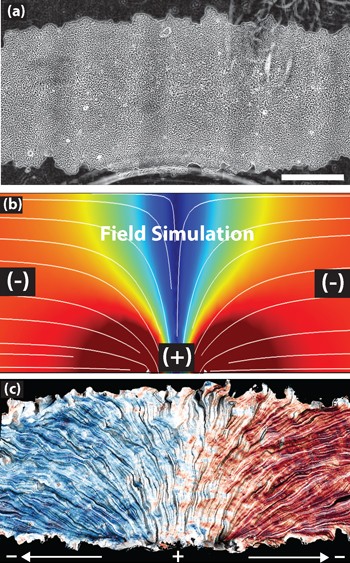
The top image shows a patch of epithelial cells. The white lines in the middle image mark the electric current flowing from positive to negative over the cells. The bottom image shows how the cells track the electric field, with blue indicating leftward migration and red signaling rightward movement. (Images by Daniel Cohen)
Videos show the effect of electric fields on the movement of epithelial cells. The first clip shows the cells migrating normally until the electric field is turned on, causing the population to move right. In the second video, the electric field causes the population of cells to make a U-turn. (Video by Daniel Cohen) Researchers at UC Berkeley found that an electrical current can be used to orchestrate the flow of a group of cells, an achievement that could establish the basis for more controlled forms of tissue engineering and for potential applications such as "smart bandages” that use electrical stimulation to help heal wounds. In the experiments, described in a study published this week , the researchers used single layers of epithelial cells, the type of cells that bind together to form robust sheathes in skin, kidneys, cornea and other organs. They found that by applying an electric current of about five volts per centimeter, they could encourage cells to migrate along the direct current electric field. They were able to make the cells swarm left or right, to diverge or converge and to make collective U-turns.
TO READ THIS ARTICLE, CREATE YOUR ACCOUNT
And extend your reading, free of charge and with no commitment.