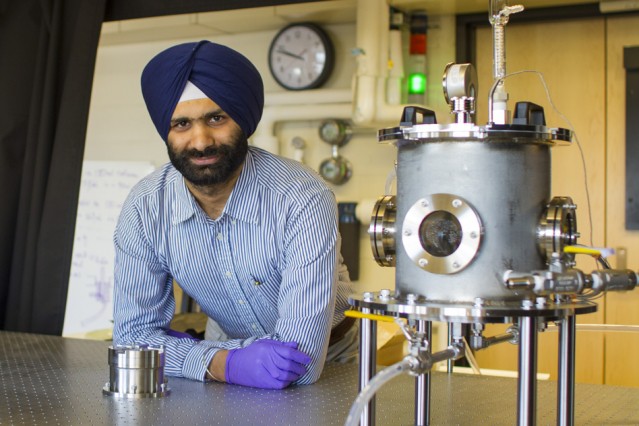
Postdoc Navdeep Singh Dhillon (pictured) studies the fundamental physical mechanisms that dictate the boiling crisis phenomenon. At right is a rig for measuring the critical heat flux (CHF) of thermally saturated water boiling on thin textured substrates, which allows researchers to visualize bubbles and measure real-time spatial substrate temperatures using infrared imaging.
The boiling of water is at the heart of many industrial processes, from the operation of electric power plants to chemical processing and desalination. But the details of what happens on a hot surface as water boils have been poorly understood, so unexpected hotspots can sometimes melt expensive equipment and disable plants. Now researchers at MIT have developed an understanding of what causes this extreme heating - which occurs when a value known as the critical heat flux (CHF) is exceeded - and how to prevent it. The new insights could make it possible to operate power plants at higher temperatures and thus significantly higher overall efficiency, they say. The findings are reported this week in the journal Nature , in a paper co-authored by mechanical engineering postdoc Navdeep Singh Dhillon, professor of nuclear science and engineering Jacopo Buongiorno, and associate professor of mechanical engineering Kripa Varanasi. "Roughly 85 percent of the worldwide installed base of electricity relies on steam power generators, and in the U.S. it's 90 percent," Varanasi says. "If you're able to improve the boiling process that produces this steam, you can improve the overall power plant efficiency." The bubbles of vapor that characterize boiling, familiar to anyone who has ever boiled water on a stove, turn out to limit energy efficiency.
TO READ THIS ARTICLE, CREATE YOUR ACCOUNT
And extend your reading, free of charge and with no commitment.