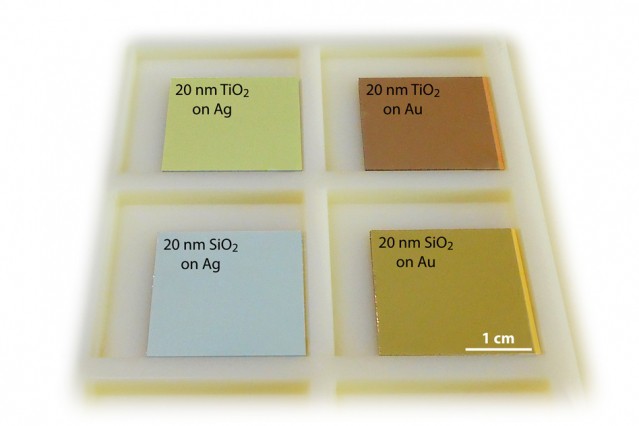
Remarkable color change when different dielectric thin films (low-index dielectric SiO2 and high-index dielectric TiO2) are deposited onto noble metals (Ag and Au). The color change is due to the light absorption via surface plasmons, which are strongly enhanced by the quantum spillover effect at the interface of a noble metal and a high-index dielectric.
Researchers at MIT and elsewhere have found a way to significantly boost the energy that can be harnessed from sunlight, a finding that could lead to better solar cells or light detectors. The new approach is based on the discovery that unexpected quantum effects increase the number of charge carriers, known as electrons and "holes," that are knocked loose when photons of light of different wavelengths strikes a metal surface coated with a special class of oxide materials known as high-index dielectrics. The photons generate what are known as surface plasmons - a cloud of oscillating electrons that has the same frequency as the absorbed photons The surprising finding is reported this week in the journal Physical Review Letters by authors including MIT's Nicholas Fang, an associate professor of mechanical engineering, and postdoc Dafei Jin. The researchers used a sheet of silver coated with an oxide, which converts light energy into polarization of atoms at the interface. "Our study reveals a surprising fact: Absorption of visible light is directly controlled by how deeply the electrons spill over the interface between the metal and the dielectric," Fang says. The strength of the effect, he adds, depends directly on the dielectric constant of the material - a measure of how well it blocks the passage of electrical current and converts that energy into polarization. "In earlier studies," Fang says, "this was something that was overlooked." Previous experiments showing elevated production of electrons in such materials had been chalked up to defects in the materials.
TO READ THIS ARTICLE, CREATE YOUR ACCOUNT
And extend your reading, free of charge and with no commitment.