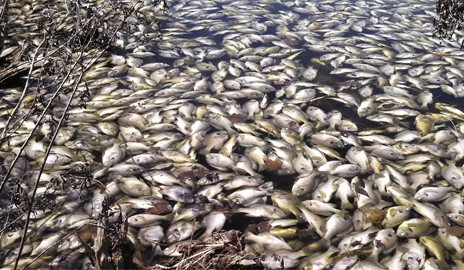
Large numbers of dead sunfish and largemouth bass in April 2014 following a severe winter on Wintergreen Lake, Kalamazoo County, Michigan. (Photo courtesy of G. Mittelbach)
Mass die-offs of animals may be increasing in frequency and - for birds, fishes, and marine invertebrates - in severity as well, according to a study of 727 mass mortality events since 1940. Despite the ecological importance of individual mass mortality events, in which a larger than normal number of individuals die within a population, little research has been conducted on patterns across mass mortality events. The new study will help researchers better assess trends in mass mortality events and their causes, according to the authors of the paper in the Jan. 12 issue of the Proceedings of the National Academy of Sciences. "The initial patterns are surprising, in terms of the documented changes to frequencies of occurrences, magnitudes of each event, and the causes of mass mortality," said Samuel Fey, a postdoctoral fellow in the Department of Ecology and Evolutionary Biology at Yale and co-lead author of the paper. "These data also show that we have a lot of room to improve how we document and study these types of rare events." Fey, along with fellow researchers at the University of San Diego and University of California-Berkeley, report that the magnitude of the die-offs has increased in birds, fishes, and marine invertebrates, held steady among mammals, and decreased in frogs and amphibians. The authors recognized that more scientific research has been done on mass mortality events in the last few decades but said even accounting for this "discovery bias" does not explain all of the increase in such events.
TO READ THIS ARTICLE, CREATE YOUR ACCOUNT
And extend your reading, free of charge and with no commitment.