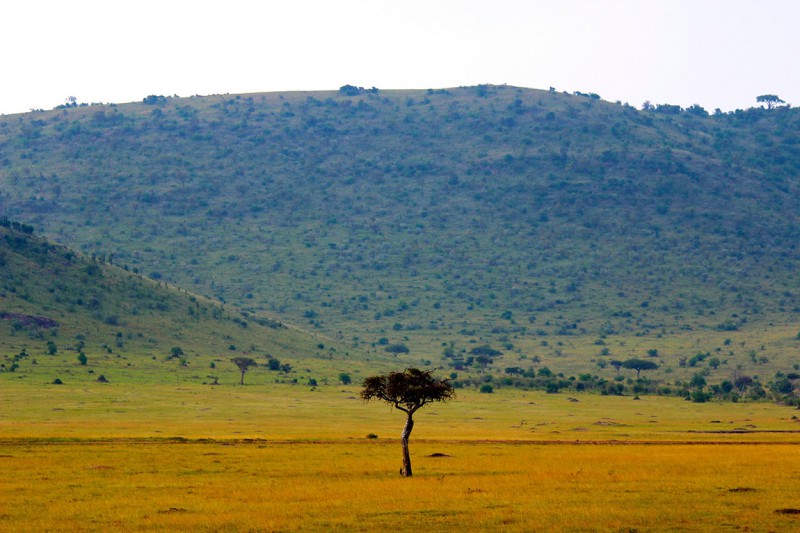
Princeton University researchers might have finally provided a solution to the ecological riddle of why tree abundance on Africa’s grassy savannas diminishes in response to heavy rainfall despite scientists’ expectations to the contrary. The researchers found that the ability of grasses to more efficiently absorb and process water gives them an advantage over trees such as the acacia (pictured). (Photo by Kev Moses, Licensed under CC BY 2.0.)
More rain leads to fewer trees in the African savanna Posted October 19, 2015; 11:30 a.m. by Angela Page for the Princeton Environmental Institute In 2011, satellite images of the African savannas revealed a mystery: these rolling grasslands, with their heavy rainfalls and spells of drought, were home to significantly fewer trees than researchers had expected. Scientists supposed that the ecosystem's high annual precipitation would result in greater tree growth. Yet a 2011 study found that the more instances of heavy rainfall a savanna received, the fewer trees it had. To this ecological riddle, Princeton University researchers might have finally provided a solution. In a study published in the Proceeding of the National Academy of Sciences, researchers use mathematical equations to show that physiological differences between trees and grasses are enough to explain the curious phenomenon. The researchers found that under very wet conditions, grasses have an advantage because they can quickly absorb water and support high rates of photosynthesis, the process by which plants convert sunlight into energy. Trees, with their tougher leaves and roots, are able to survive better in dry periods because of their ability to withstand water stress.
TO READ THIS ARTICLE, CREATE YOUR ACCOUNT
And extend your reading, free of charge and with no commitment.