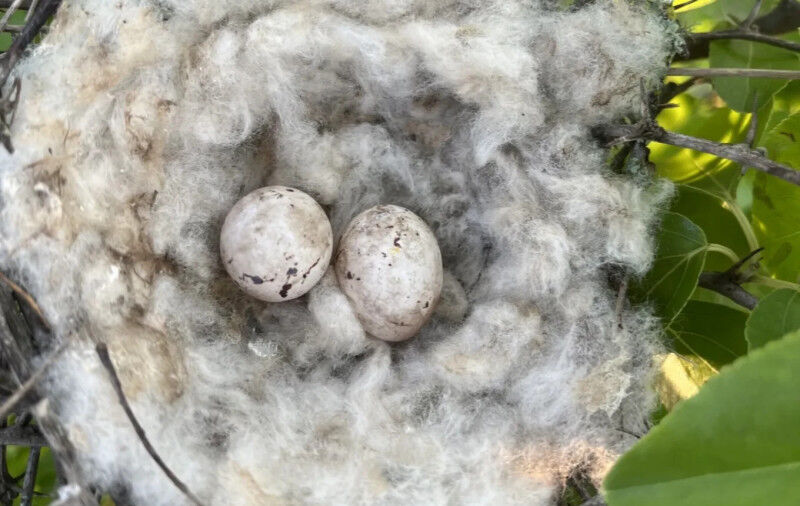
The research took place in Mbuluzi Game Reserve in Eswatini. In this savannah area, researchers studied wild cotton ( Gossypium herbaceum ) and the nest-building behaviour of two species of mousebirds. These were naturally occurring plants, not commercial cotton fields.
Cotton is usually associated with wind dispersal: the light, fluffy fibres around the seeds seem ideal for that. But the study shows that birds may be just as important.
The research focused on two species of mousebirds in Eswatini. These birds use the soft cotton fibres as nest lining. In several nests that were examined, large numbers of cotton seeds were found - sometimes more than 200 per nest. The seeds remained intact in the fibres. Using colour markings, researchers were able to trace where the seeds had come from. Some had been moved more than a kilometre from the parent plant.
Notably, mousebirds normally remain within a few hundred metres of their nest during the breeding season. To collect cotton, they therefore travelled greater distances than expected. When nests fall apart after the breeding season - often during the rainy season - the seeds end up on the ground under favourable conditions for germination.
Cameras at the nests showed that the birds deliberately collected the cotton and carried it to the nest in their beaks. The material was incorporated into the nest structure and was even reused from old nests. Because of this reuse, seeds may possibly be dispersed even further in multiple steps.
Sjouke Anne Kingma, researcher at Wageningen University & Research:
"We saw that the birds actively searched for cotton and brought it to their nest. That means that their behaviour contributes to the dispersal of this plant. Cotton is such a familiar material for people and it is remarkable that its natural function - and thus why cotton fibres evolved - has remained hidden for so long."
Implications for biodiversity
This study shows that nest building is not only important for the birds themselves, but also for the dispersal of plants. Seed dispersal determines where plants establish and how populations remain connected."Animals are not only inhabitants of ecosystems, they also shape them. By building their nests with plant material, they influence where plants establish and how biodiversity develops."
In a time of climate change and habitat loss, this insight is important. If animals disperse seeds over greater distances and also carry them across barriers such as rivers or fragmented landscapes, plants can reach new areas. This contributes to the resilience of ecosystems. The loss of animal species may therefore also have consequences for plant communities.
A PNAS study in the tropical freshwater fish Neolamprologus pulcher shows that not only the number of siblings matters, but how young animals interact early in life shapes later social skills.
A recent study by behavioural biologists from Wageningen University & Research and the German Primate Research Centre has uncovered a remarkable phenomenon among wild chimpanzees in West Africa: the use of stones to produce sound, presumably as a form of communication.
The Behavioural Ecology Group of chairholder Marc Naguib studies the causes and consequences of decisions animals make with a focus on social contexts.