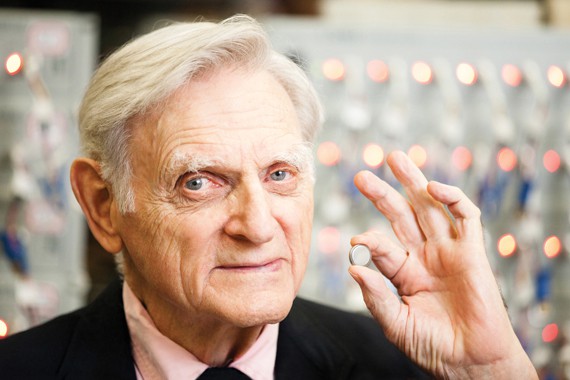
John Goodenough and his lithium-ion battery invention. Goodenough and his team have identified a new cathode material for sodium-ion batteries.
Photo by Marsha Miller
AUSTIN, Texas - Led by the inventor of the lithium-ion battery, a team of researchers in the Cockrell School of Engineering at The University of Texas at Austin has identified a new safe and sustainable cathode material for low-cost sodium-ion batteries. During the past five years, sodium-ion batteries have emerged as a promising new type of rechargeable battery and an alternative to lithium-ion batteries because sodium, better known as the main element of salt, is abundant and inexpensive. In contrast, lithium-ion batteries are limited by high production costs and availability of lithium. If researchers can figure out how to improve the performance and safety of sodium-ion batteries enough to widely commercialize them, then they could one day be used for wind and solar energy storage and to power electric vehicles. To that end, professor John Goodenough, the inventor of the lithium-ion battery, and his team have identified a new cathode material made of the nontoxic and inexpensive mineral eldfellite, presenting a significant advancement in the race to develop a commercially viable sodium-ion battery. The researchers reported their findings Aug. 27 in the journal Energy & Environmental Science .
TO READ THIS ARTICLE, CREATE YOUR ACCOUNT
And extend your reading, free of charge and with no commitment.