Reza Saberianfar
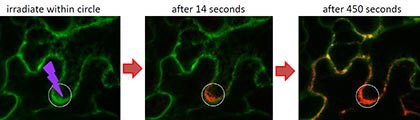
Microwave ovens, penicillin and Velcro are examples of scientific discoveries made by accident. Now, Cornell researchers announce another accidental discovery: When a green fluorescent protein (GFP) is exposed to specific wavelengths of laser light, it turns red. Students engaged in a photo-bleaching technique discovered the color change when they accidentally used a different laser wavelength to look at the GFP. "No one had ever noticed the GFP could be converted to red under this particular wavelength under very ordinary conditions," said Maureen Hanson, professor of molecular biology and genetics and the paper's senior author. Green fluorescent protein is used as an essential research tool to tag and label proteins or parts of a cell so they glow green and can then be followed as they move or interact in biological pathways, according to the study published July 7 in the journal Scientific Reports. Scientists engineer organisms so that certain proteins or cellular organelles will glow green to determine how fast a particular protein degrades or how fast and where a particular organelle moves around a cell. Now, researchers may use laser light to convert a subset of those marked proteins or organelles to red, to compare and further study cell parts in even greater detail.
TO READ THIS ARTICLE, CREATE YOUR ACCOUNT
And extend your reading, free of charge and with no commitment.