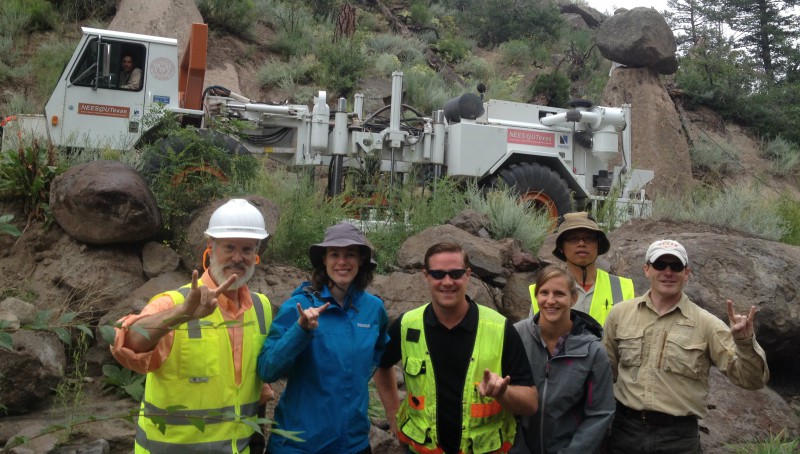
A team of UT Austin earthquake experts recently conducted field testing at Los Alamos National Laboratory in New Mexico. Kenneth Stokoe (far left) shown in front of large shaker truck with UT Austin graduate students and staff, including Associate Brady Cox (far right).
Photo courtesy of the Cockrell School of Engineering
AUSTIN, Texas - The National Science Foundation (NSF) has selected the Cockrell School of Engineering at The University of Texas at Austin for a $3.8 million grant to support research that aids in the design of buildings and infrastructure that can better withstand earthquakes, hurricanes, storm surges and other natural hazards. The grant is part of the new Natural Hazards Engineering Research Infrastructure (NHERI) program announced today by the NSF. The five-year program will provide a network of shared, state-of-the-art, experimental research facilities located at seven universities across the country. At UT Austin, the grant will establish NHERI@UTexas , a natural hazards experimental facility aimed at protecting our nation's existing infrastructure and helping in the planning and design of new infrastructure that is more resilient to earthquakes, hurricanes and other wind and water hazards. Professor Kenneth Stokoe II and his team, including associate professor Brady Cox and assistant professor Patricia Clayton, will lead NHERI@UTexas. "The grant will allow us and other NSF-supported researchers to develop new knowledge that will be used to make our nation's bridges, levees and buildings safer and more resilient," Stokoe said. "With the resources provided by NHERI, we believe we will make a difference as engineers in preventing natural hazards from becoming natural disasters." NHERI@UTexas will advance new methods of earthquake, wind and water hazards research and will have three main focus areas: subsurface imaging, soil characterization and structural evaluation.
TO READ THIS ARTICLE, CREATE YOUR ACCOUNT
And extend your reading, free of charge and with no commitment.