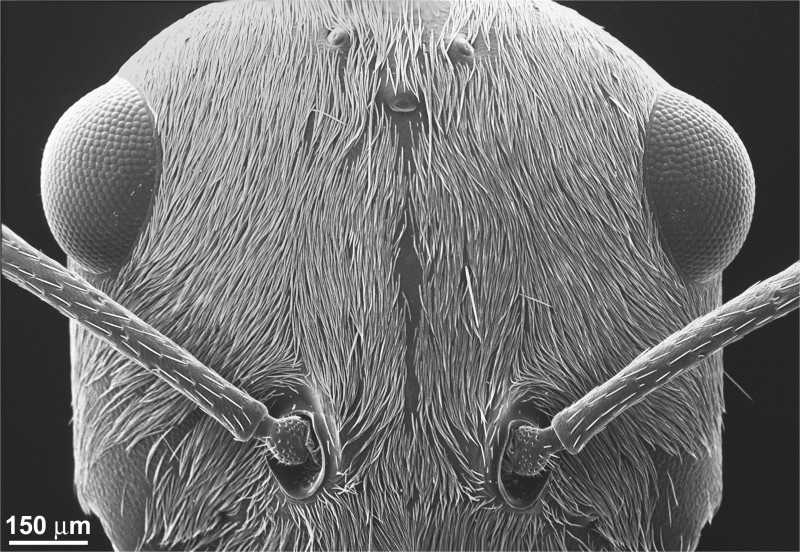
A scanning electron microsocope (SEM) view of the Saharan silver ant’s head densely covered in hairs. Norman Nan Shi and Nanfang Yu, Columbia Engineering
The Saharan silver ant forages for food in one of the hottest terrestrial environments on Earth. Covered in tiny silver hairs, the ant looks like a ball of mercury skittering across the scorching desert sand. Now an international team of researchers that includes a University of Washington electrical engineer has discovered two key strategies that enable Saharan silver ants ( Cataglyphis bombycina ) to survive in blistering temperatures of up to 158 degrees Fahrenheit. In a study published online June 18 , the researchers demonstrate how the ant's uniquely shaped silver hairs work across an extremely broad range of the electromagnetic spectrum to reflect sunlight and shed heat. The findings could lead to biologically inspired coatings for passive radiative cooling of objects such as buildings, vehicles or even clothing. The team led by Columbia Engineering 's Nanfang Yu found two key strategies that enable Saharan silver ants to stay cool. The silver hairs reflect visible and near-infrared light, including sunlight that pounds the Saharan desert.
TO READ THIS ARTICLE, CREATE YOUR ACCOUNT
And extend your reading, free of charge and with no commitment.