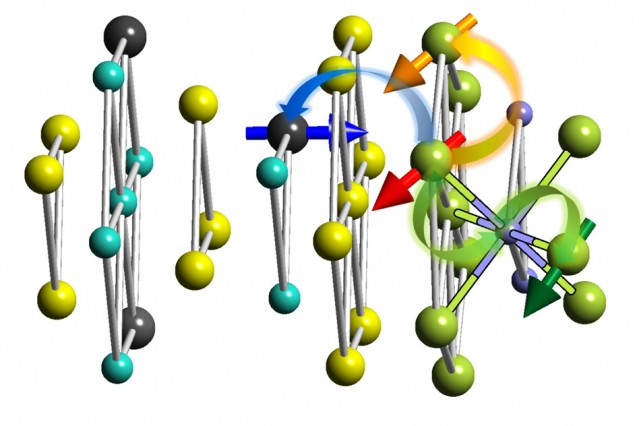
This diagram shows the layered structure analyzed for its magnetic properties. Yellow spheres represent tellurium atoms; light blue spheres represent antimony-bismuth; and black spheres represent sulfur. The black sphere with an arrow represents an atom of dopant, and green spheres with arrows show atoms of europium. Different colored arrows show various ways an europium ion can be affected by the interface between the materials: within the plane via Heisenberg interaction (orange), between the planes (green) through super-exchange interaction, or spin-polarized states at the topological insulator surface (blue).
An exotic kind of magnetic behavior, driven by the mere proximity of two materials, has been analyzed by a team of researchers at MIT and elsewhere using a technique called spin-polarized neutron reflectometry. They say the new finding could be used to probe a variety of exotic physical phenomena, and could ultimately be used to produce key components of future quantum computers. The novel phenomenon occurs at the boundary between a ferromagnet and a type of material called a topological insulator, which blocks electricity from flowing through all of its bulk but whose surface is, by contrast, a very good electrical conductor. In the new work, a layer of topological insulator material is bonded to a ferromagnetic layer. Where the two materials meet, an effect takes place called proximity-driven magnetic order, producing a localized and controllable magnetic pattern at the interface. The research is described in a paper appearing this week in the journal Physical Review Letters , written by MIT doctoral student Mingda Li, postdoc Cui-Zu Chang, professor of nuclear science and engineering Ju Li, senior scientist Jagadeesh Moodera, and seven others. This "proximity magnetism" effect could create an energy gap, a necessary feature for transistors, in a topological insulator, making it possible to turn a device off and on as a potential building block for spintronics, says Mingda Li, the lead author of the paper.
TO READ THIS ARTICLE, CREATE YOUR ACCOUNT
And extend your reading, free of charge and with no commitment.