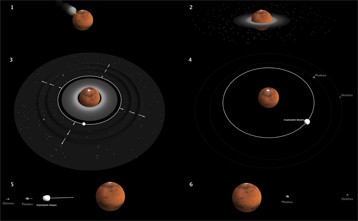
 © Antony Trinh / Royal Observatory of Belgium Chronology of events that may have created Phobos and Deimos.
Mars is struck by a protoplanet one-third its size (1). A debris disk forms within a few hours. The elementary building blocks of Phobos and Deimos (grains smaller than a micrometer) condense directly from gas in the outer part of the disk (2).
The debris disk soon produces a moon near Mars that moves further away and propagates its two areas of dynamical influence like ripples (3), which over the course of a few thousand years causes the accretion of more dispersed debris into two small moons, Phobos and Deimos (4).
Under the effect of the tidal pull of Mars, the large moon falls back to the planet within approximately five million years (5), while smaller Phobos and Deimos take up their current positions in the ensuing billions of years (6).
© Antony Trinh / Royal Observatory of Belgium Chronology of events that may have created Phobos and Deimos.
Mars is struck by a protoplanet one-third its size (1). A debris disk forms within a few hours. The elementary building blocks of Phobos and Deimos (grains smaller than a micrometer) condense directly from gas in the outer part of the disk (2).
The debris disk soon produces a moon near Mars that moves further away and propagates its two areas of dynamical influence like ripples (3), which over the course of a few thousand years causes the accretion of more dispersed debris into two small moons, Phobos and Deimos (4).
Under the effect of the tidal pull of Mars, the large moon falls back to the planet within approximately five million years (5), while smaller Phobos and Deimos take up their current positions in the ensuing billions of years (6).
Where did the two natural satellites of Mars, Phobos and Deimos, come from? For a long time, their shape suggested that they were asteroids captured by Mars. However, the shape and course of their orbits contradict this hypothesis. Two independent and complementary studies provide an answer to this question. One of these studies, to be published in The Astrophysical Journal and predominantly conducted by researchers from the CNRS and Aix-Marseille Université
1, rules out the capture of asteroids, and shows that the only scenario compatible with the surface properties of Phobos and Deimos is that of a giant collision. In the second study, a team of French, Belgian, and Japanese researchers used cutting-edge digital simulations to show how these satellites were able to form from the debris of a gigantic collision between Mars and a protoplanet one-third its size. This research, which is the result of collaboration between researchers from Université Paris Diderot and Royal Observatory of Belgium, in collaboration with the CNRS, Université de Rennes 1
2 and the Japanese Institute ELSI, is published on July 4, 2016 . The origin of the two Martian moons, Phobos and Deimos, remained a mystery. Due to their small size and irregular shape, they strongly resembled asteroids, but no one understood how Mars could have « captured » them and made them into satellites with almost circular and equatorial orbits. According to a competing theory, toward the end of its formation Mars suffered a giant collision with a protoplanet: but why did the debris from such an impact create two small satellites instead of one enormous moon, like the Earth's?
TO READ THIS ARTICLE, CREATE YOUR ACCOUNT
And extend your reading, free of charge and with no commitment.
Your Benefits
- Access to all content
- Receive newsmails for news and jobs
- Post ads