A New Spin on Quantum Computing: Scientists Train Electrons with Microwaves
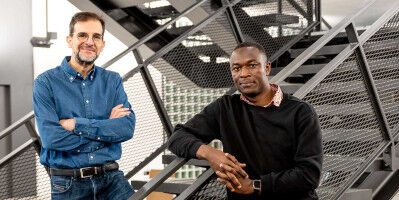
From left, Berkeley Lab scientists Thomas Schenkel, Qing Ji and Peter Seidl at the NDCX-II (Neutralized Drift Compression Experiment II), which produces powerful ion beams. Researchers are exploring how to use NDCX-II to process exotic materials, like the silicon-bismuth sample used in a recent microwave-based experiment relevant to quantum computing. In what may provide a potential path to processing information in a quantum computer, researchers have switched an intrinsic property of electrons from an excited state to a relaxed state on demand using a device that served as a microwave "tuning fork." The team's findings could also lead to enhancements in magnetic resonance techniques, which are widely used to explore the structure of materials and biomolecules, and for medical imaging. The international research team, which included scientists at the Department of Energy's Lawrence Berkeley National Laboratory (Berkeley Lab), demonstrated how to dramatically increase the coupling of microwaves in a specially designed superconducting cavity to a fundamental electron property called spin-which, like a coin, can be flipped. By zapping an exotic silicon material developed at Berkeley Lab with the microwaves, they found that they could rapidly change the electron spins from an excited state to a relaxed, ground state by causing the electrons to emit some of their energy in the form of microwave particles known as photons. A silicon sampled doped with bismuth atoms (left image) that is just 150 nanometers thick is fitted with a superconducting resonator that includes a capacitor (black, in left image; light gray in center image) and an inductive wire (red line in the left image) that is 5 microns in diameter.