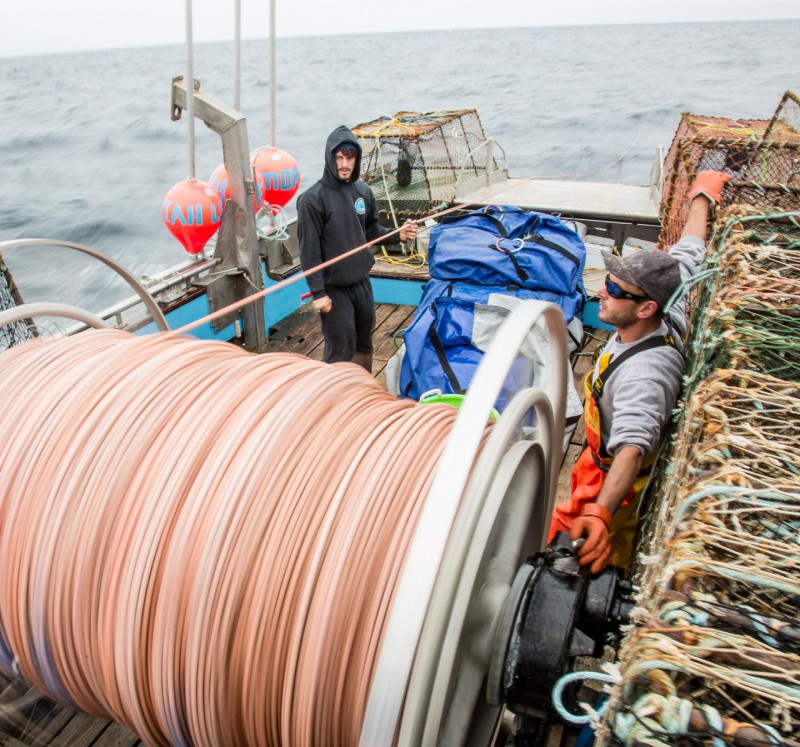
Fishermen place Sablefish pots off the coast of Half Moon Bay, California. Ethan Righter
Catch shares, a form of "rights-based” fisheries management adopted for several fisheries in the Pacific Northwest, may put an end to the kind of daring exploits chronicled in the "Deadliest Catch. A new study of fishing practices found that the "risky” behavior that makes fishing one of the most dangerous lines of work dropped sharply following the adoption of catch shares management in the West Coast fixed gear sablefish fishery. Fewer boats fished during the stormiest weather, with fishing on the highest wind days dropping by 79 percent under catch shares, according to The decline in rough-weather fishing represents "a revolution in risk-taking behavior by fishermen,” wrote the authors, Lisa Pfeiffer of NOAA Fisheries' Northwest Fisheries Science Center and Trevor Gratz of the University of Washington. The researchers said they expect corresponding reductions in injuries, pollution events, vessel losses, search-and-rescue missions and deaths from fishing accidents under catch shares management. Read the full story from NOAA Fisheries. Co-author Gratz, while an undergraduate student at the UW, was supported by an endowment from Rao and Usha Varanasi to complete an internship at the Northwest Fisheries Science Center, where he worked with Pfeiffer. UW part of team that drilled first deep ice core at the South Pole - 5 mins ago - Dangerous fishing may be endangered, new study finds - 39 mins ago - Three UW professors win Presidential Early Career Award for Scientists and Engineers - 18 hours ago - David Levy addresses digital overload in 'Mindful Tech' - 23 hours ago More
TO READ THIS ARTICLE, CREATE YOUR ACCOUNT
And extend your reading, free of charge and with no commitment.