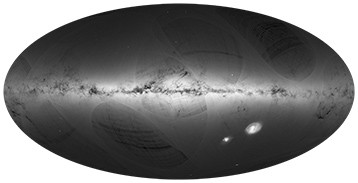
 © ESA/Gaia/DPAC. Image generated by: André Moitinho & Márcia Barros (CENTRA - University of Lisbon) on behalf of DPAC. A high spatial resolution sky map based on observations by the European Space Agency’s astrometry mission Gaia. The different shades of grey show the number of sources detected per unit area. The lightest areas typically correspond to 500,000 sources per square degree (roughly the size of the object Omega Cen near the center of the map). The Galaxy is clearly visible, while the dark regions where few sources are detected show, with excellent resolution, the clouds of gas and dust that absorb starlight. The striations and large, more or less oval structures are caused by Gaia scanning the sky over a period of 14 months, and will disappear in subsequent versions.
With one billion stars mapped in a thousand days, European researchers have shown that they are not afraid to tackle the most daunting tasks. The work was carried out by 450 researchers from 25 European countries, including around a hundred scientists from France, mainly at the CNRS, Observatoire de Paris and Observatoire de la Côte d'Azur
1, with major participation by the French space agency CNES. Using the Gaia spacecraft, launched on 19 December 2013, scientists have catalogued the position of 1.15 billion stars, and in addition measured the velocity and distance of two million of them relative to the Sun. ESA
2 and the European consortium DPAC
3 are releasing the mission's first findings on September 14. The announcement represents the most precise and detailed sky survey ever carried out. The Gaia spacecraft both rotates and orbits around the Earth, while surveying the sky with its two telescopes. Equipped with 106 CCDs forming the equivalent of a camera with a resolution of a billion pixels, it surveys 50 million stars per day, each time carrying out ten measurements, which represents a total of 500 million data points per day.
TO READ THIS ARTICLE, CREATE YOUR ACCOUNT
And extend your reading, free of charge and with no commitment.
Your Benefits
- Access to all content
- Receive newsmails for news and jobs
- Post ads