© LIGO Laboratory (first two images) and Virgo / Nicola Baldocchi 2015 From left to right: the two LIGO detectors (in Hanford and Livingston, US) and the Virgo detector .
On 26 December 2015, scientists from the LIGO and Virgo collaborations received an unexpected Christmas gift when the Advanced LIGO detectors recorded a new gravitational wave signal, three months after the first detection
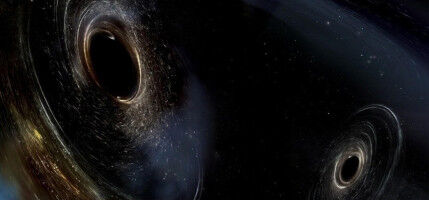
1. And once again, the signal—a tiny distortion of spacetime—came from the final spinning 'dance' of two black holes on the point of merging, a phenomenon known as coalescence. This second observation confirms that such cataclysmic events are relatively frequent, making it likely that more will be detected from late 2016, when the Advanced LIGO (US) and Advanced Virgo (Italy) resume operation following upgrading work. This will help scientists to better understand pairs of black holes, bodies that are so dense that neither light nor matter can escape from them. The discovery, made by an international collaboration including CNRS teams, is announced on 15 June 2016 at the meeting of the American Astronomical Society in San Diego, and is published in the journal Physical Review Letters . Three months after announcing the first detection of gravitational waves
1, scientists from the LIGO and Virgo collaborations have reported a second observation of the merger of two black holes, revealed by the gravitational waves emitted during the event. Although the signal is weaker than the first one, this new finding has also been confirmed with a confidence level of over 99.
TO READ THIS ARTICLE, CREATE YOUR ACCOUNT
And extend your reading, free of charge and with no commitment.
Your Benefits
- Access to all content
- Receive newsmails for news and jobs
- Post ads