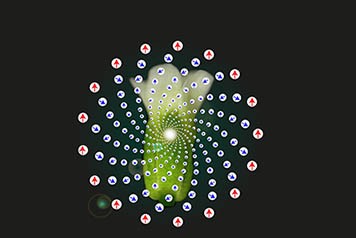
Random directions of growth yield flowers of the correct size and shape. Credit S. Tsugawa, Hokkaido University.
Random directions of growth yield flowers of the correct size and shape. Credit S. Tsugawa, Hokkaido University. An international team (Cornell University, Hokkaido University, Max Planck Institute, Ecole normale supérieure de Lyon / Université Claude Bernard Lyon 1 / CNRS / INRA) unravels how random cell growth contributes to making organs reach the correct size and shape. This study was published in Developmental Cell on July 11th. What makes an elephant look like an elephant, or a mouse look like a mouse? How do our two arms reach less than 1% dissimilarity in length? Despite continuous progress in developmental biology, we still do not know the answers to such deceptively simple questions. In other terms, one of the most important open questions in developmental biology is how an organ "knows" to stop growing when it reaches the correct size and shape. Plants are perfectly suited to address such questions because they can produce many almost identical flowers.
TO READ THIS ARTICLE, CREATE YOUR ACCOUNT
And extend your reading, free of charge and with no commitment.