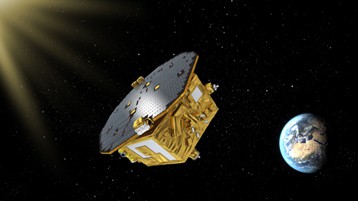
Mission accomplished for the LISA Pathfinder spacecraft after only two months of science operations. Not only were the technologies needed for the future eLISA
1 gravitational wave space observatory validated, but the performance of the ESA demonstrator also exceeded the project specifications by a factor of five, and was very close to requirements for eLISA . These first results, which involved the Astroparticule et Cosmologie laboratory (CNRS/Université Paris Diderot/CEA/Observatoire de Paris), with support from CNES, are published on 7 June 2016 in the journal Physical Review Letters . They represent a major step towards space-based gravitational astronomy
2, which will make it possible to study phenomena such as mergers between supermassive black holes. LISA Pathfinder is a technical and scientific success. After the first 55 days of science operations, the spacecraft's performance has proved to exceed by a factor of five the project specifications for the mission, which aims to test the technologies required for a space-based gravitational wave observatory. LISA Pathfinder contains two test masses, small cubes made of gold and platinum, which are not mechanically connected to the rest of the spacecraft but 'floating' in cavities 38 cm apart, surrounded by the instrumentation required to measure their position.
TO READ THIS ARTICLE, CREATE YOUR ACCOUNT
And extend your reading, free of charge and with no commitment.
Your Benefits
- Access to all content
- Receive newsmails for news and jobs
- Post ads