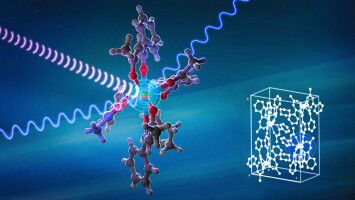
© François-Xavier Coudert, CNRS. A disordered hybrid organic-inorganic porous material.
Hybrid organic-inorganic materials, which were developed approximately twenty years ago – notably by Gérard Férey, laureate of the CNRS 2010 Gold Medal, and his team – are known firstly for their extreme porosity. This remarkable property offers a diverse range of applications in the fields of energy, health, and sustainable development. Researchers from the Institut de recherche de chimie Paris (CNRS/Chimie ParisTech) and Cambridge University have conducted an inventory of research to date, which has revealed surprising new properties for these materials. The more their crystalline structure has defects, the greater their performance. This research was published on December 20 . Hybrid organic-inorganic materials are highly porous crystalline structures, with an internal surface that can represent more than 6,000 m
2 per gram. This enables them to immobilize a large number of molecules, hence their use as adsorbents in the capture of carbon dioxide for example.
TO READ THIS ARTICLE, CREATE YOUR ACCOUNT
And extend your reading, free of charge and with no commitment.
Your Benefits
- Access to all content
- Receive newsmails for news and jobs
- Post ads