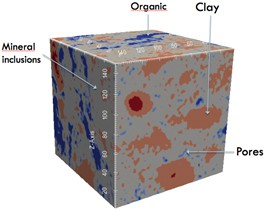
 © M. Hubler (MIT) and J. Gelb (Carl Zeiss X-ray Microscopy) X-ray microscopy (XRM) image of an untreated sample of gas shale, showing inclusions of pyrite, clay, organic matter and other minerals.
Although shale gas development is attracting a lot of attention, the recovery method used, hydraulic fracturing, or fracking, is raising increasing concerns. In order to develop more environmentally friendly methods, researchers need models and simulations validated by experiment and capable of reconstructing the complexity of such geological structures. With this in mind, molecular models of kerogen, whose breakdown produces shale gas, have been developed by researchers from the CNRS/MIT International Joint Unit 'Multi-Scale Materials Science for Energy and Environment' and the Institut de Sciences des Matériaux de Mulhouse (CNRS/Université de Haute-Alsace). Such models, derived from experimentally determined properties of kerogen, can be used to investigate the behavior of this organic material. This work is published on the website of Nature Materials on 1 February 2016. Petroleum and natural gas are formed by the breakdown of kerogen, which in turn is produced by the decomposition of organic matter. Although this process can give rise to conventional deposits, it can also take place within highly heterogeneous units such as shales.
TO READ THIS ARTICLE, CREATE YOUR ACCOUNT
And extend your reading, free of charge and with no commitment.
Your Benefits
- Access to all content
- Receive newsmails for news and jobs
- Post ads