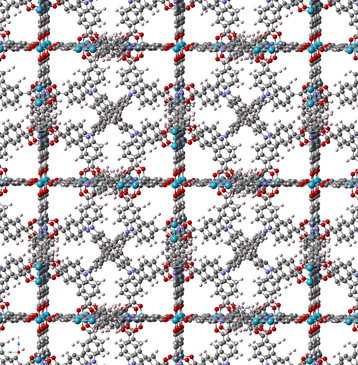
 © F.-X. Coudert / CNRS Simulation of DUT-49 atom arrangement when it has not contracted
High-tech sponges of the infinitely small, nanoporous materials can capture and release gaseous or liquid chemicals in a controlled way. A team of French and German researchers from the Institut de Recherche de Chimie Paris (CNRS/Chimie ParisTech) and the Institut Charles Gerhardt de Montpellier (CNRS/Université de Montpellier/ENSCM)
1 has developed and described one of these materials, DUT-49, whose behavior is totally counterintuitive. When pressure is increased for a sample of DUT-49 to absorb more gas, the material contracts suddenly and releases its contents—as if, when inhaling, the lungs contracted and expelled the air that they contained. Capturing toxic molecules in ambient air, storing hydrogen, targeting drug release—the list of applications that could use flexible nanoporous materials is endless. These materials use the large surface area in their pores to capture and store gaseous or liquid molecules: this phenomenon is called adsorption
2. Their pores can adsorb impressive quantities of products; they keep getting bigger until they reach their flexibility limit. A French and German team has designed a novel type of nanoporous material: DUT-49.
TO READ THIS ARTICLE, CREATE YOUR ACCOUNT
And extend your reading, free of charge and with no commitment.
Your Benefits
- Access to all content
- Receive newsmails for news and jobs
- Post ads




