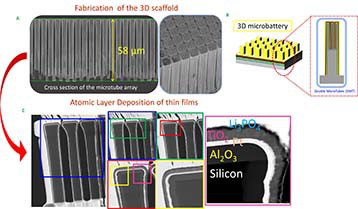
A: 3D scaffold of the microbattery machined in a silicon substrate to form double microtubes. B: schematic of a 3D Li-ion microbattery showing the stacking of materials deposited in thin layers using ALD. C: Transmission electron microscopy analysis of thin film coatings
In the race towards miniaturization, a French-US team—mostly involving researchers from the CNRS, Université de Lille, Université de Nantes and Argonne National Laboratory (US) as part of the Research Network on Electrochemical Energy Storage (RS2E)1—has succeeded in improving the energy density of a rechargeable battery without increasing its size (limited to a few square millimeters in mobile sensors). This feat was achieved by developing a 3D structure made of microtubes, the first step towards producing a complete microbattery. The first experiments have demonstrated the excellent conductivity of the battery's solid electrolyte, whose highly encouraging performance is published in the journal Advanced Energy Materials on October 11, 2016. In the era of connected devices, intelligent connected microsensors require miniature embedded energy sources with great energy density. For ultra-thin—or planar—microbatteries, increased energy density means using thicker layers of materials, which has obvious limitations. A second method—used by the authors of the publication—consists in machining a silicon wafer2 and producing an original 3D structure made of simple or double microtubes. 3D batteries keep their 1mm2 footprint area, but develop a specific area of 50 mm2—an enhancement factor of 50! These robust microtubes are large enough (of the order of the micron) to be coated with multiple layers of functional materials3.
TO READ THIS ARTICLE, CREATE YOUR ACCOUNT
And extend your reading, free of charge and with no commitment.