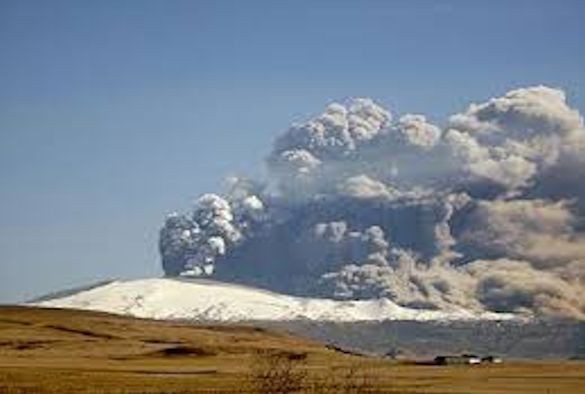
The Eyjafjalla volcano in Iceland, which erupted in 2010, resulted in significant air travel disruption
Scientists at the University of Liverpool and the Ludwig Maximilian University of Munich have developed a new method to assess the impact of volcanic ash on jet engines. Little is known scientifically about the effects of volcanic ash on aircraft but the impact it can have on the aviation industry was evidenced when the Eyjafjalla volcano in Iceland erupted in 2010 resulting in prolonged disruption to air travel and significant economic losses exceeding £1 billion. Volcanologists from the University analysed samples of volcanic ash from nine different volcanoes to see how its chemical composition controls its behavior upon melting at jet engine temperatures which range between 1100 °C and 2000 °C. Volcanic ash is widely recognized as being a potentially fatal hazard for aircraft primarily through melting and sticking to the inside of the turbines but is particularly problematic if it affects the cooling system. Current guidelines Guidelines on the threat of volcanic ash particles on jet engines, which were introduced in 1982, rely on early engineering studies which tested the impact of sand and dust particles on road vehicles. Volcanic ash is however chemically different and estimating its potential hazard is complicated by the fact that chemical composition can vary widely amongst volcanoes. Professor Yan Lavallée , volcanologist at the University's School of Environmental Sciences , said: "Our experiments are the first study to test the conditions for which ash can melt using chemical criteria.
TO READ THIS ARTICLE, CREATE YOUR ACCOUNT
And extend your reading, free of charge and with no commitment.