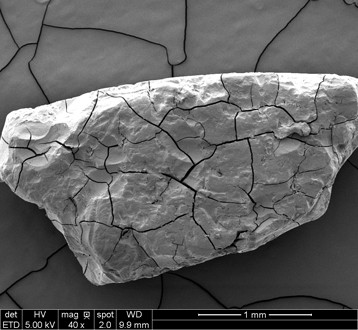
 © IMRCP/CNRS A particle of plastic (around 3 mm long) viewed with a scanning electron microscope.
The cracks seen at the surface (face exposed to the sun) are caused by photochemical degradation. They promote the fragmentation of the debris into smaller particles, along the cracks.
© IMRCP/CNRS A particle of plastic (around 3 mm long) viewed with a scanning electron microscope.
The cracks seen at the surface (face exposed to the sun) are caused by photochemical degradation. They promote the fragmentation of the debris into smaller particles, along the cracks.
First discovered by sailors, the masses of plastic debris floating at the center of vast ocean vortices called gyres are today under close scrutiny by scientists. To better understand the fragmentation of microplastics under the effect of light and abrasion by waves, researchers combined physico-chemical analyses with statistical modeling. They were thus able to show that pieces of plastic debris behave in very different ways according to their size. The bigger pieces appear to float flat at the surface of the water, with one face preferentially exposed to sunlight. However, the researchers observed fewer small-sized debris (around 1 mg) than predicted by the mathematical model. Several hypotheses are put forward to explain this lack. The findings were obtained by researchers from CNRS and Université Toulouse III – Paul Sabatier
1 from samples collected during the 7th Continent Expedition.
TO READ THIS ARTICLE, CREATE YOUR ACCOUNT
And extend your reading, free of charge and with no commitment.
Your Benefits
- Access to all content
- Receive newsmails for news and jobs
- Post ads