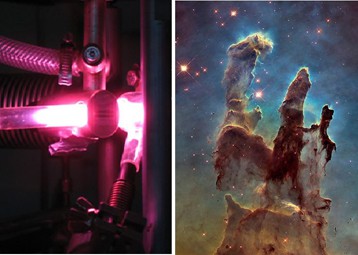
 © L. Le Sergeant d’Hendecourt (CNRS) / NASA, ESA, and the Hubble Heritage Team (STScI/AURA) Ultraviolet processing of pre-cometary ices (left) reproduces the natural evolution of interstellar ices observed in molecular clouds (right, the ’Pillars of Creation’), leading to the formation of sugar molecules.
Researchers have for the first time shown that ribose, a sugar that is one of the building blocks of genetic material in living organisms, may have formed in cometary ices. To obtain this result, scientists at the Institut de Chimie de Nice (CNRS/Université Nice Sophia Antipolis) carried out a highly detailed analysis of an artificial comet created by their colleagues at the Institut d'Astrophysique Spatiale (CNRS/Université Paris-Sud). Along with other teams
1, including one at the SOLEIL synchrotron, they propose the first realistic scenario for the formation of this key compound, which had never been detected in meteorites or cometary ices until now. The genetic material of all living organisms on Earth, as well as of viruses, is made up of nucleic acids, DNA and RNA
2. RNA, which is considered more primitive, is thought to have been one of the first molecules characteristic of life to appear on Earth. Scientists have long wondered about the origin of these biological compounds. Some of them believe that the Earth was seeded by comets or asteroids that contained the basic building blocks needed to form such molecules.
TO READ THIS ARTICLE, CREATE YOUR ACCOUNT
And extend your reading, free of charge and with no commitment.
Your Benefits
- Access to all content
- Receive newsmails for news and jobs
- Post ads