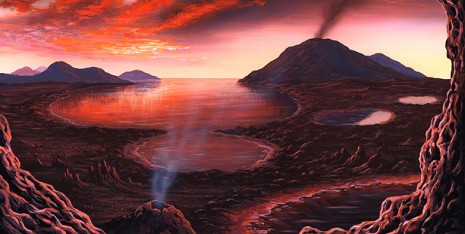
Current scientific theory postulates that the precursors of life originated in shallow lagoons. (Visualisations: Science Photo Library / Richard Bizely)
Experiments performed by ETH scientists have shown that it is remarkably easy for protein-like, two-dimensional structures - amyloids - to form from basic building blocks. This discovery supports the researchers? hypothesis that primal life could have evolved from amyloids such as these. The story starts at least four billion years ago, when there was no living matter on the planet. Sometime around then, smaller chemical compounds formed into larger organised structures capable of self-reproduction. And so the early precursors of life were born. Exactly which molecules were involved, and what they were made of, is the biggest puzzle in evolutionary history. However, ETH Professor Roland Riek and his senior scientist Jason Greenwald have a compelling idea: these primordial lifelike structures could well have been proteinaceous aggregates, or amyloids.
TO READ THIS ARTICLE, CREATE YOUR ACCOUNT
And extend your reading, free of charge and with no commitment.