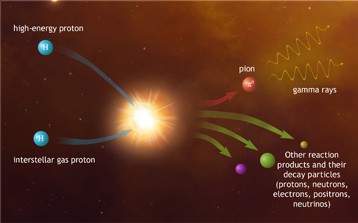
 © Dr Mark A. Garlick/ H.E.S.S. Collaboration Caption: Artist’s impression of the giant molecular clouds surrounding the Galactic Centre, bombarded by very high energy protons accelerated in the vicinity of the central black hole and subsequently shining in gamma rays.
For more than ten years the H.E.S.S. observatory in Namibia, run by an international collaboration of 42 institutions in 12 countries, has been mapping the centre of our galaxy in very-high-energy gamma rays. These gamma rays are produced by cosmic rays from the innermost region of the Galaxy. A detailed analysis of the latest H.E.S.S. data reveals for the first time a source of this cosmic radiation at energies never observed before in the Milky Way: the supermassive black hole at the centre of the Galaxy, likely to accelerate cosmic rays to energies 100 times larger than those achieved at the largest terrestrial particle accelerator, the LHC at CERN. The Earth is constantly bombarded by high energy particles (protons, electrons and atomic nuclei) of cosmic origin, particles that comprise the so-called “cosmic radiation”. These “cosmic rays” are electrically charged, and are hence strongly deflected by the interstellar magnetic fields that pervade our galaxy.
TO READ THIS ARTICLE, CREATE YOUR ACCOUNT
And extend your reading, free of charge and with no commitment.
Your Benefits
- Access to all content
- Receive newsmails for news and jobs
- Post ads