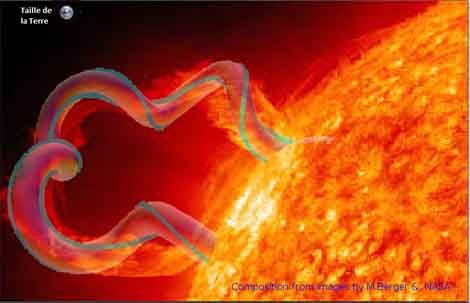
 © G.Valori, M. Berger & NASA SDO Artist’s impression of a solar flare and the twisted magnetic field that carries away the ejected solar material.
The emerging discipline of space meteorology aims to reliably predict solar flares so that we may better guard against their effects. Using 3D numerical models
1, an international team headed by Etienne Pariat, a researcher at LESIA (Observatoire de Paris / CNRS / Université Paris Diderot / UPMC), has discovered a proxy that could be used to forecast an eruptive event. The proxy is associated with magnetic helicity, which reflects the extent of twist and entanglement of the magnetic field. The study is published in the journal Astronomy and Astrophysics dated 17 May 2017. Solar flares or eruptions are one of the most violent phenomena in the Solar System. They coincide with a sudden, violent reconfiguration of the magnetic field, releasing huge amounts of energy that can eject billions of tons of solar material into space at speeds of over a thousand kilometers per second. Although numerous parameters have been studied, the probability of forecasting a major flare one day in advance is currently no greater than 40%.
TO READ THIS ARTICLE, CREATE YOUR ACCOUNT
And extend your reading, free of charge and with no commitment.
Your Benefits
- Access to all content
- Receive newsmails for news and jobs
- Post ads