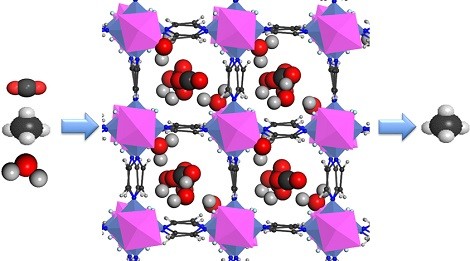
 © Guillaume Maurin At left, natural gas contains CO2, methane and water. Upon contact with KAUST-8 at center, the CO2 and water are trapped. At right, only the methane remains.
The fields of gas filtration and purification require materials whose porosity can be perfectly controlled. Zeolites, which are porous inorganic compounds, are the most frequently used today, although large amounts of energy are needed to recycle them. Researchers from King Abdullah University of Science and Technology (KAUST)
1, l'Institut Lavoisier Versailles (CNRS/Université de Versailles Saint-Quentin-en-Yvelines), and l'Institut Charles Gerhardt Montpellier (CNRS/Université de Montpellier/ENSCM) recently synthesized KAUST-8, a metal organic framework (MOF) that dehydrates natural gas, purifies it of CO2, and has the advantage of being easy to recycle. When natural gas is extracted from the soil, the water and CO2 it contains must be eliminated in order to have only methane. This separation takes place through the use of various materials such as zeolites, which are incredibly porous aluminosilicate crystals. While very effective, they require a great deal of energy to be regenerated between each use. Researchers at KAUST University, l'Institut Lavoisier Versailles, and l'Institut Charles Gerhardt Montpellier have succeeded in conceiving a highly stable and easily recyclable new material: KAUST-8.
TO READ THIS ARTICLE, CREATE YOUR ACCOUNT
And extend your reading, free of charge and with no commitment.
Your Benefits
- Access to all content
- Receive newsmails for news and jobs
- Post ads