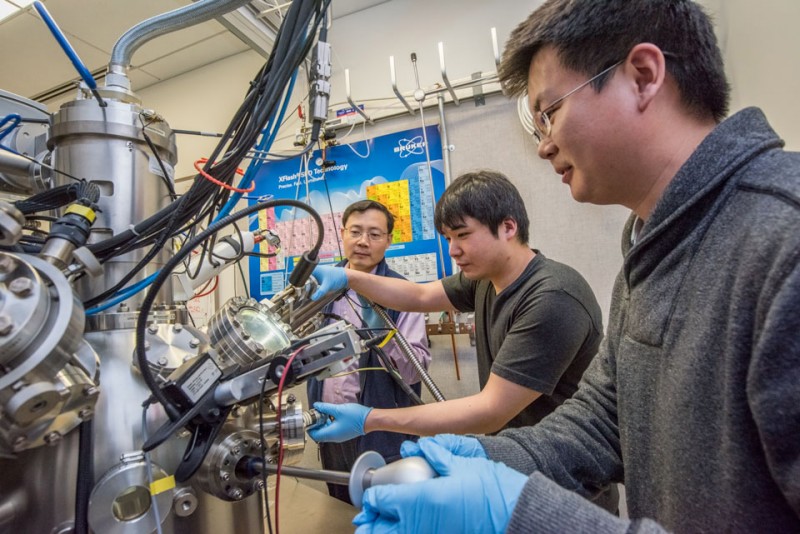
Berkeley Lab scientists Junqiao Wu, Changhyun Ko, and Fan Yang (l-r) are working at the nano-Auger electron spectroscopy instrument at the Molecular Foundry, a DOE Office of Science User Facility. They used the instrument to determine the amount of tungsten in the tungsten-vanadium dioxide (WVO2) nanobeams. (Credit: Marilyn Chung/Berkeley Lab)
Berkeley-led study finds law-breaking property in vanadium dioxide that could lead to applications in thermoelectrics, window coatings. There's a known rule-breaker among materials, and a new discovery by an international team of scientists adds more evidence to back up the metal's nonconformist reputation. According to a new study led by scientists at the Department of Energy's Lawrence Berkeley National Laboratory (Berkeley Lab) and at the University of California, Berkeley, electrons in vanadium dioxide can conduct electricity without conducting heat. The findings, to be published in the Jan. 27 issue of the journal Science , could lead to a wide range of applications, such as thermoelectric systems that convert waste heat from engines and appliances into electricity. For most metals, the relationship between electrical and thermal conductivity is governed by the Wiedemann-Franz Law. Simply put, the law states that good conductors of electricity are also good conductors of heat.
TO READ THIS ARTICLE, CREATE YOUR ACCOUNT
And extend your reading, free of charge and with no commitment.