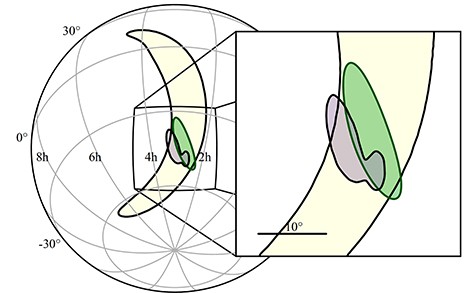
 © Collaboration LIGO-Virgo Localization of the source of gravitational waves
In yellow: localization obtained with the two LIGO detectors.
In green: localization obtained using the data from the three detectors (LIGO and Virgo), through a real-time analysis.
In mauve: more accurate localization obtained after more extensive analysis.
© Collaboration LIGO-Virgo Localization of the source of gravitational waves
In yellow: localization obtained with the two LIGO detectors.
In green: localization obtained using the data from the three detectors (LIGO and Virgo), through a real-time analysis.
In mauve: more accurate localization obtained after more extensive analysis.
Scientists in the LIGO and Virgo collaborations have achieved the first ever three-detector observation of the gravitational waves emitted by the merger of two black holes. This is the first signal detected by the Advanced Virgo instrument, which joined observing runs by the two LIGO detectors on 1 August, and confirms that it is fully operational. It opens the way to considerably more accurate localization of the sources of gravitational waves. The discovery is published by the international collaboration that runs the three detectors, including teams from the CNRS, in the journal Physical Review Letters . The announcement was made at a press briefing during a meeting of the G7-science
1 in Turin, Italy. On the very same day, the CNRS awarded two Gold Medals to physicists Alain Brillet and Thibault Damour for their major contributions to the detection of gravitational waves
2. Black holes are the final stage in the evolution of the most massive stars.
TO READ THIS ARTICLE, CREATE YOUR ACCOUNT
And extend your reading, free of charge and with no commitment.
Your Benefits
- Access to all content
- Receive newsmails for news and jobs
- Post ads